
Dry Well vs Pop-Up Emitter in Clay Soil: Which Works Better in Tulsa?
When a downspout line or French drain cannot reach the street, the two end points homeowners hear about most are a dry well and a pop-up emitter. Both are buried at the end of a pipe. Both are sold as a tidy way to get roof and yard water out of sight. In Tulsa's clay, they behave very differently.
This guide explains how each one works, what clay soil does to them, and how to tell which one, if either, fits your yard.
How a pop-up emitter works
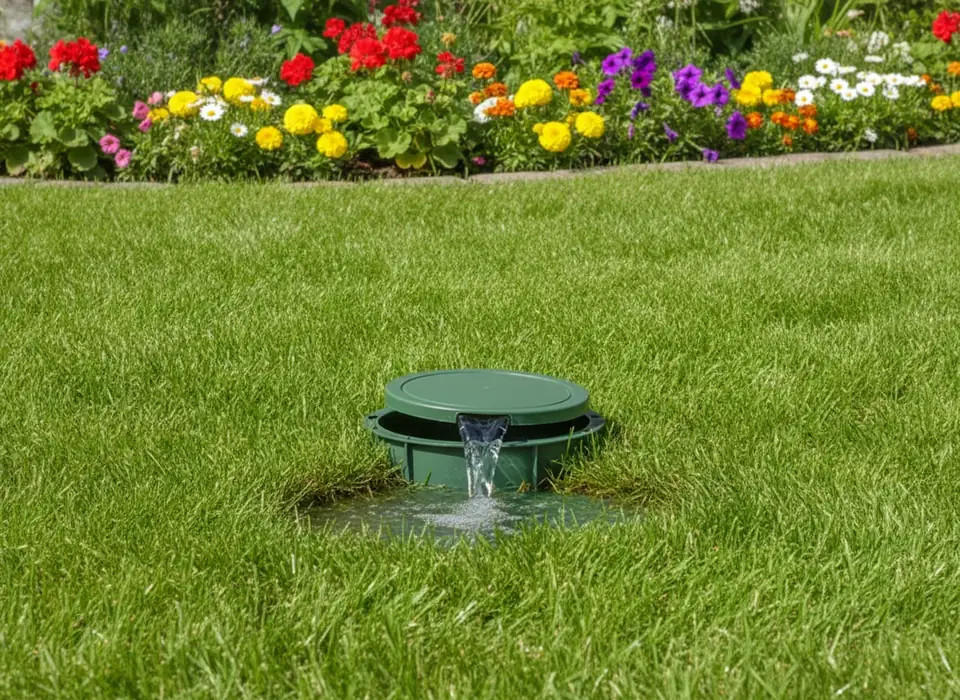
A pop-up emitter is a round cap, usually a few inches across, set flush with the lawn at the end of a buried pipe. When water fills the line, pressure lifts the cap and water spills out onto the grass. When the flow stops, the cap drops back down. Nothing is stored underground; the emitter just moves the outlet away from the house to a spot where water can spread out.
For it to work, the emitter has to sit lower than where the water enters the pipe. If the lawn is flat or slopes back toward the house, water stays in the line instead of coming out.
How a dry well works
A dry well is an underground holding space: a plastic chamber, a perforated basin, or a pit filled with gravel. Water runs in during a storm, the well holds it, and the water slowly soaks into the surrounding soil. The whole idea depends on the soil absorbing water fast enough to empty the well before the next rain.
Why clay soil changes the answer
About 47% of Tulsa County is mapped as high or very-high shrink-swell clay, and the largest single soil, Dennis silt loam (20.6% of the county), is rated "somewhat poorly drained" by USDA. USDA's soil data show the slowest layers of several common county soils passing water at very roughly 0.03 to 0.16 inches per hour.
That number matters most for a dry well. If the soil around it takes in water that slowly, a well that fills in a heavy storm may stay full for a long time. Tulsa averages about 12.3 days a year with an inch or more of rain, and April through June brings about 36% of the year's total (NOAA 1991 to 2020 normals). A well that has not emptied from Monday's storm has little room for Wednesday's.
Soil also varies from lot to lot. Some parts of the area, especially along the Arkansas River, have sandier soils that drain much better. That is why it is worth asking a contractor to check your actual soil, sometimes with a simple percolation test, before you pay for a dry well.
Side by side
| Pop-up emitter | Dry well | |
|---|---|---|
| What it does | Releases water onto the lawn at a lower point | Stores water underground until it soaks in |
| Needs | Fall from the inlet down to the emitter | Soil that absorbs water at a useful rate |
| In Tulsa clay | Works if there is enough slope; the water still has to soak in or run off at the surface | Often empties slowly; can stay full between storms |
| Common problems | Silt and grass clogging, mower damage, water sitting in the line | Silt filling the well, overflow during long rain |
| Published cost | Priced per foot like a shallow drain plus the emitter or outlet; get it itemized | $1,500 to $5,000 installed (Fixr, Jan 2025) |
All figures are published estimates, not quotes, and Tulsa companies' quotes vary.
Where pop-up emitters run into trouble
- Standing water in the line. On a flat run, some water always stays in the pipe. In silty soil, fines settle out and slowly choke it.
- The emitter is too close to the house or the neighbor. It has to release water somewhere that drains away safely and doesn't damage adjoining properties.
- Debris from the gutters. Leaves and shingle grit from the roof travel down the line. A screen or cleanout at the downspout helps.
- Lawn care. Mowers and aerators can crack the cap, and thick turf can hold it shut.
Where dry wells run into trouble
- Slow soil. The main risk in Tulsa clay, as above.
- Too much roof. A large roof section in a spring storm sends a lot of water at once. Ask how the contractor sized the well for the area draining into it.
- Silt. Without a filter or a catch basin upstream, sediment builds up inside the well over time.
- Overflow. Ask where water goes when the well is full. It should overflow somewhere harmless, not against the slab or toward a neighbor.
Fix the cheap things first. Before paying for either, make sure gutters are clean, downspouts are not pouring right at the foundation, and the soil next to the house slopes away from it. Sometimes a longer extension or a small grade fix moves enough water that a buried outlet is not needed. Good drainage can help reduce moisture swings in Tulsa's clay soils, but neither a dry well nor an emitter is foundation repair.
When neither one is the right fix
If the lot is flat, the soil is dense clay, and there is a lot of roof or yard water, a contractor may suggest a different approach: regrading or a swale to move surface water, a French drain carried to the street, or a sump basin with a pump. Each has its own tradeoffs. The French drain outlet guide compares those options, and the clay soil drainage post goes deeper on what Tulsa soils do with water.
If the plan sends water toward the street, remember that Tulsa requires a separate right-of-way permit for work in the street right-of-way. Whatever the outlet, drainage has to be conveyed without causing damage to adjoining properties.
Questions to ask a contractor
- Why do you recommend this outlet for my yard, and what else did you consider?
- How much fall is there from the downspout or drain to the emitter?
- For a dry well: how was it sized, did you check how fast my soil drains, and where does it overflow?
- Is there a cleanout or filter so the line can be flushed?
- Have you planned for sprinkler lines? OKIE811 doesn't mark private lines.
The downspout and gutter drainage page covers underground lines, emitters and dry wells in more detail, and the Tulsa French drain cost guide lists the published price ranges. When you're ready, describe the problem on the free quote form. Tulsa French Drain Pros is a free matching service, and independent local drainage companies can reply with quotes. There is no obligation.
Questions people ask
Do dry wells work in Tulsa clay soil?
Often slowly. Much of Tulsa County has clay subsoil that USDA rates somewhat poorly drained, so water soaks out of a dry well at a slow rate. A well can stay full between storms. Soil varies by lot, so ask the contractor to check how fast your soil drains before you commit to one.
Is a pop-up emitter better than a dry well?
Neither is better everywhere. A pop-up emitter just moves water to a lower spot on the lawn, so it needs slope from the inlet to the emitter. A dry well stores water underground, so it needs soil that absorbs it. On a sloped Tulsa lot an emitter is often simpler; on a flat lot both can struggle.
Why does my pop-up emitter stay closed with water in the line?
Usually the emitter is not low enough below the inlet, the line is clogged with silt or gutter debris, or turf is holding the cap down. A contractor can flush the line, check the slope with a level, and move or lower the emitter if needed. Cleaning gutters regularly helps keep the line clear.
How much does a dry well cost?
Fixr lists dry wells at $1,500 to $5,000 installed as of January 2025. That is a published estimate, not a quote, and Tulsa companies' prices vary with size, depth, digging conditions and how far the pipe runs. Ask for the well, pipe and lawn repair to be itemized separately.