
Neighbor Water Runoff in Oklahoma: Your Options in Tulsa
Few drainage problems are as frustrating as water that isn't yours. A neighbor's new patio, a regraded lot uphill or a row of downspouts aimed at the fence can send water into your yard every time it storms. This post explains what the City of Tulsa's drainage rule says, the practical steps homeowners usually take, and what drainage work can and can't do on your side of the line.
This is not legal advice. Tulsa French Drain Pros is a free matching service, not a law firm and not a drainage contractor. Surface-water disputes depend on the facts, the property records and Oklahoma law. If you're considering a claim, or a neighbor is making one against you, talk to an Oklahoma attorney.
What Tulsa's drainage rule says
The City of Tulsa's Residential Site Plan Guidebook (January 2025) sets drainage rules for new homes, additions, pools and "other significant activities that could change the drainage patterns and characteristics of property that could impact neighboring properties." It says:
"All residential properties must accept and convey drainage without causing damage to adjoining properties. Flow coming from off-site onto the property cannot be blocked." "Flow from off-site must be conveyed so that it does not cause damage to neighbors. Any additional flow originating on the property must be collected and conveyed to the street, if possible, or other approved drainage conveyance facility."
Read that both ways. Your uphill neighbor is expected to convey water without causing damage to your property. And you, in turn, can't simply wall off water that naturally flows onto your lot; it has to be carried through. The guidebook also says new houses must have roof drainage directed to the street or other approved conveyance. How these rules apply to a specific dispute, or to work done years ago, is a question for the city and, for a claim, an attorney. Suburbs such as Broken Arrow, Owasso and Jenks have their own rules.
Step 1: figure out where the water really comes from
Before talking to anyone, watch a storm. Tulsa gets about a dozen days a year with an inch or more of rain (NOAA 1991 to 2020), so you won't wait long.
- Take dated photos and short videos of water entering your yard, and where it pools.
- Note where it crosses the line: a downspout outlet, a low spot in the fence line, a driveway edge, a swale.
- Check your own roof water. Sometimes the worst puddle is fed by your own downspouts.
- Note when it started. A change after a neighbor's construction is useful information.
- Look at your plat for a drainage easement. Water running along a platted swale may be doing exactly what it was designed to do.
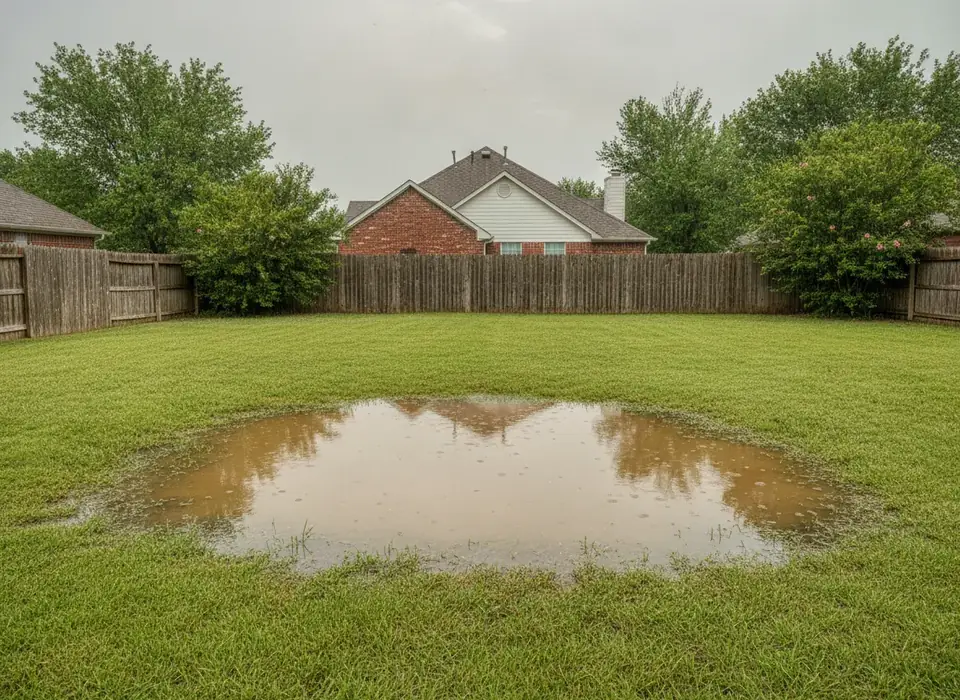
Step 2: talk to your neighbor
Many runoff problems come from something simple: a downspout extension pointed the wrong way, a filled-in swale, a flower bed border acting as a dam. A calm conversation with your photos often gets further than a letter. Some neighbors split the cost of a shared fix, such as restoring a swale along the property line. Put any agreement in writing.
Step 3: check with the HOA and the city
- HOA. Many subdivisions in Jenks, Bixby, Owasso and Broken Arrow have covenants about drainage easements and swales. Check your HOA covenants and plat for drainage easements before regrading or trenching, and ask the HOA whether a neighbor's change breaks them.
- City of Tulsa. For a problem with public drainage, such as a blocked inlet or ditch, call 311. The city can also tell you whether a permit was required for a neighbor's grading.
- Floodplain. If the water is coming from a creek rather than a neighbor's lot, request a Floodplain Determination from the City of Tulsa. French drains handle yard and roof runoff, not creek or river flooding.
Step 4: if it's a legal dispute, talk to an Oklahoma attorney
If talking doesn't work and the water is causing damage, the next step is a legal one, and we can't advise on it. Neighbor drainage disputes are generally civil matters. An Oklahoma attorney can tell you how state law and the city's rules apply to your facts, what records to gather and what your options are. Bring your photos, dates and any quotes for repair.
What drainage work can do on your side
While a dispute plays out, or if the water is simply natural uphill flow, homeowners often choose to manage it on their own lot. The goal is to carry the water through, not block it.
| Approach | What it does | Published range |
|---|---|---|
| Swale along the property line | Catches surface flow and carries it to the street side | Priced as grading: $1,500–$2,600 per 1,000 sq ft (Fixr) |
| Curtain drain | Intercepts water seeping in from uphill | $10–$25 per foot (Fixr) |
| French drain | Collects soggy ground and pipes it to an outlet | $23–$36 per foot in Tulsa (HomeBlue) |
| Catch basin with solid pipe | Picks up a low spot and carries water away | Itemized by the contractor |
What not to do: don't build a berm, wall or raised bed to dam water coming from uphill, don't redirect it back at the neighbor or onto another lot, and never tie a drain into a sanitary sewer line. Under Tulsa's rule, flow from off-site can't be blocked and drainage must be conveyed without causing damage to adjoining properties.
Inside Tulsa city limits, the city's Watershed Development Permit rules cover excavating, grading and regrading, and any work in the street right-of-way (like running a pipe through the curb) needs a separate right-of-way permit. Ask your contractor whether your project needs a permit, or call City of Tulsa Development Services (311). Suburbs have their own rules. Oklahoma law requires anyone digging for hire to contact OKIE811 at least 48 hours ahead (excluding weekends and holidays). It's free. Sprinkler lines and other private lines aren't marked, so your contractor should plan for them.
If your neighbor says your water floods them
The same rule runs the other way. If your downspouts, patio or new grading send water onto the neighbor's lot, it's worth fixing whether or not anyone files a complaint. Start with downspout and gutter drainage, then look at grading and swales. Ask any contractor exactly where the water will exit. If a claim is being made against you, talk to an Oklahoma attorney.
Questions to ask a drainage contractor
- Where will the water exit, and how does that avoid sending it onto another lot?
- Does the plan carry uphill water through rather than blocking it?
- Is there a drainage easement on my plat that affects the work?
- Does the project need a permit where I live, and who applies?
- Will you put the drainage plan and outlet location in the written quote?
Oklahoma doesn't issue a state license for general, landscape or drainage contractors. Plumbing, electrical and mechanical work does require a Construction Industries Board license. Ask any contractor for proof of liability insurance, and use a licensed plumber for anything tied into your home's plumbing.
For a wider look at the options, see yard drainage and standing water, French drain installation and the cost guide. To have independent local companies look at your yard and quote a fix on your side of the line, use the free quote form or call (877) 265-2390.
Frequently asked questions
Can my neighbor drain water onto my property in Tulsa?
The City of Tulsa's Residential Site Plan Guidebook says all residential properties must accept and convey drainage without causing damage to adjoining properties, and flow from off-site cannot be blocked. How that applies to your situation depends on the facts. For a legal question, talk to an Oklahoma attorney.
Can I block water coming from my neighbor's yard?
Tulsa's rule says flow coming onto a property from off-site cannot be blocked; it must be conveyed so it does not cause damage. Drainage work on your side usually carries the water through, with a swale or drain to the street side, rather than damming it.
Who do I call about neighbor runoff in Tulsa?
Start with your neighbor and, if you have one, your HOA. Call City of Tulsa 311 about public drainage problems or permit questions. For a legal claim or dispute, talk to an Oklahoma attorney.
Will a French drain fix water coming from my neighbor's yard?
It can help manage water on your lot if it carries the water to a proper outlet, often alongside a swale or curtain drain. It does not settle a dispute, and it should never send water onto another lot or into a sanitary sewer.