
French Drain vs Swale: Which One Does Your Tulsa Yard Need?
When water crosses a Tulsa yard or pools against the house, the two most common fixes are a French drain and a swale. One moves water underground through gravel and pipe. The other reshapes the surface so water runs where you want it. They solve overlapping problems, they cost different amounts, and on many lots the best answer uses both. Here's how to tell which one fits.
Tulsa French Drain Pros is a free matching service, not a drainage contractor. The independent local companies who reply to your request will recommend and price the work for your lot.
What is a swale?
A swale is a shallow, wide, gently sloped channel in the ground, usually covered in grass. It catches surface water and carries it along the low line to an outlet, often the street side of the lot. Many newer subdivisions in Jenks, Bixby, Owasso and Broken Arrow were built with swales along side and rear property lines. They work quietly until someone fills one in, puts a fence or shed in it, or the ground settles.
What is a French drain?
A French drain is a trench lined with fabric, filled with washed gravel, with a perforated pipe in it. Water from the surface and the top layer of soil drops into the gravel, enters the pipe and runs downhill to an outlet. From above, all you see is grass or a strip of stone. It's built for water that soaks in and then sits, not just water that runs across the top.
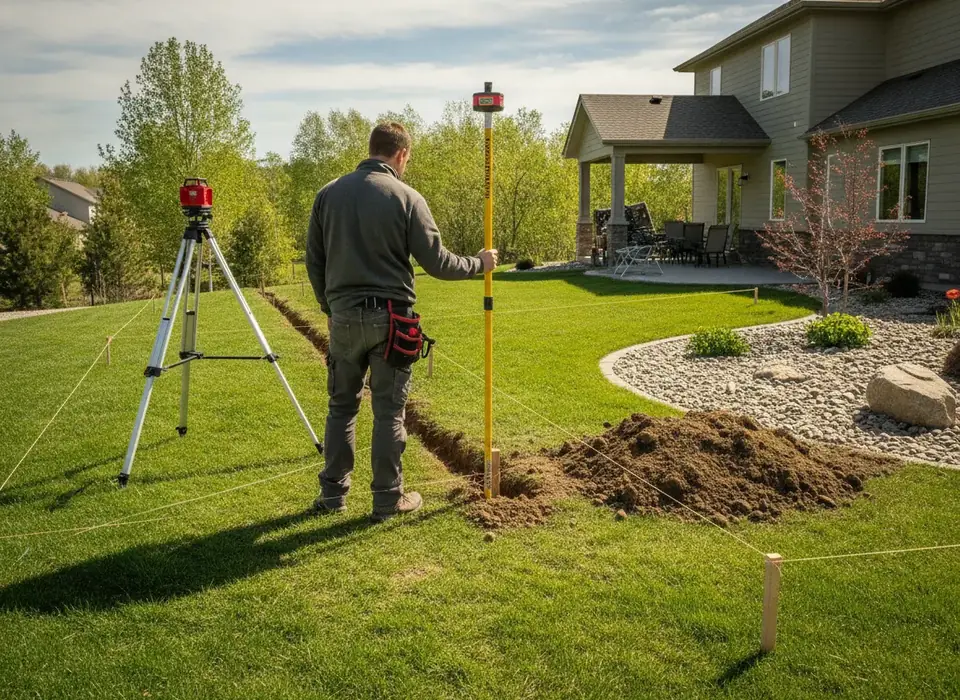
French drain vs swale at a glance
| Swale | French drain | |
|---|---|---|
| What it handles | Surface runoff, sheet flow across the lot | Water that soaks in and sits; some surface water |
| Capacity in a heavy storm | High, if wide enough and sloped | Limited by pipe size and how fast water reaches it |
| Room needed | A strip several feet wide | A narrow trench |
| Looks | A gentle dip in the lawn | Hidden, or a gravel strip |
| Maintenance | Mowing; keep it clear of fill and debris | Can clog with silt or roots; cleanouts help |
| Published cost | Priced as grading: regrading $1,500–$2,600 per 1,000 sq ft (Fixr, Jan 2025) | $23–$36 per foot in Tulsa (HomeBlue, May 2024) |
There isn't a published per-foot figure for a residential swale alone, so contractors usually price it as grading work. The regrading range above is the nearest published number. These are published estimates, not quotes.
When a swale is the better choice
- Water is flowing across the surface. If you can watch it run in from uphill or along the property line during a storm, a swale handles volume that a 4-inch pipe can't.
- You have room. Open side and rear yards with a natural fall toward the street suit swales.
- An existing swale has been lost. Restoring a platted swale that was filled or settled is often the simplest fix in a newer subdivision.
- You want less buried hardware. A grassed swale has no pipe to clog.
When a French drain is the better choice
- The ground stays soggy after the surface dries. That's subsurface water, and a swale won't reach it.
- Space is tight. A narrow side yard between two houses often can't fit a wide dip, but it can fit a trench.
- You don't want a dip in the lawn. Near patios, play areas and walkways, a hidden drain is easier to live with.
- Water is coming from uphill underground. A curtain drain, a French drain across the slope, intercepts it ($10–$25 per foot, Fixr, Jan 2025).
Why Tulsa clay often calls for both
Tulsa gets about 41 inches of rain a year, with about 12 days a year bringing an inch or more (NOAA 1991 to 2020). On slow clay, a downpour produces a lot of surface runoff fast, which favors a swale. Then the soil stays wet for days, which favors a French drain. A common combination is a swale to carry storm runoff, with a French drain under or beside the low line to pick up what soaks in. The two share an outlet. Read more in clay soil drainage in Tulsa.
Rules that apply to both
Don't move your problem next door. The City of Tulsa's Residential Site Plan Guidebook says: "All residential properties must accept and convey drainage without causing damage to adjoining properties. Flow coming from off-site onto the property cannot be blocked." A swale or drain has to carry water to the street or another approved spot, not onto a neighbor, and it can't dam water coming from uphill. Check your HOA covenants and plat for drainage easements before regrading or trenching.
Inside Tulsa city limits, the city's Watershed Development Permit rules cover excavating, grading and regrading, and any work in the street right-of-way (like running a pipe through the curb) needs a separate right-of-way permit. Ask your contractor whether your project needs a permit, or call City of Tulsa Development Services (311). Suburbs have their own rules. Because a swale is grading, the grading language matters for it as much as for a trench. Oklahoma law requires anyone digging for hire to contact OKIE811 at least 48 hours ahead (excluding weekends and holidays). It's free. Sprinkler lines and other private lines aren't marked, so your contractor should plan for them.
Questions to ask before choosing
- Where does the water come from: my roof, my yard, or uphill?
- Is the problem surface flow, soggy ground, or both?
- Where will the water exit, and is that outlet lower than the problem area?
- Is there a platted drainage easement on my lot?
- Would fixing downspouts first shrink the job? See downspout and gutter drainage.
Oklahoma doesn't issue a state license for general, landscape or drainage contractors. Plumbing, electrical and mechanical work does require a Construction Industries Board license. Ask any contractor for proof of liability insurance, and use a licensed plumber for anything tied into your home's plumbing.
For details on each approach, see yard grading and swales and French drain installation, or the French drain cost guide for prices. To have local companies look at your yard, use the free quote form or call (877) 265-2390.
Frequently asked questions
Is a swale better than a French drain?
Neither is better in general. A swale handles surface runoff and large storm volumes if you have room. A French drain handles water that soaks in and sits, and fits in tight spaces. Many Tulsa clay lots use both, sharing one outlet.
How much does a swale cost compared with a French drain?
Swales are usually priced as grading work. Fixr's January 2025 regrading range is $1,500 to $2,600 per 1,000 square feet. HomeBlue's May 2024 Tulsa French drain range is $23 to $36 per foot. These are published estimates, not quotes.
Can I fill in the swale behind my house?
Check your plat and HOA covenants first. Many newer subdivisions have drainage easements along swales, and Tulsa's rule says flow coming onto a property from off-site cannot be blocked. Ask a contractor and the city before changing it.
Do I need a permit to build a swale in Tulsa?
Tulsa's Watershed Development Permit rules cover grading and regrading inside city limits. Ask your contractor whether your project needs a permit, or call City of Tulsa Development Services (311). Suburbs have their own rules.